The big serpents loose in the Florida swamplands have been in the news lately and people down south are understandably concerned about these big constrictors ( please see note below). They are a real hazard.Now I doubt that any of these big snakes could survive one of our Northwest winters (or even summer for that matter) but it is worth noting that we have a very interesting constrictor of our own – the Rubber Boa, Charina bottae.
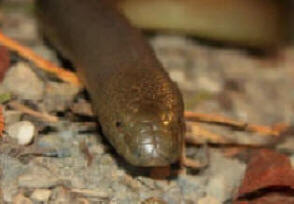
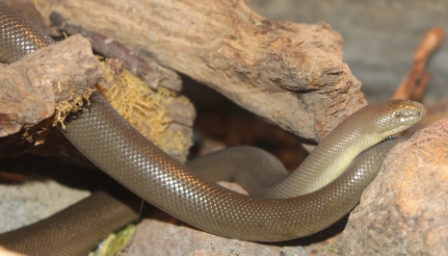
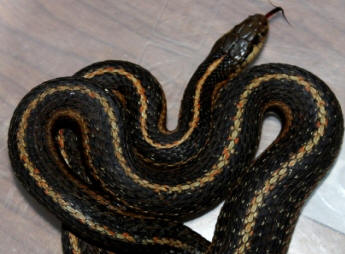
At a maximum length of less than three feet our boa constrictor is hardly a threat to anything but mice and other very small animals. They are, however, true constrictors and member or the Boidae family of snakes that include the giant pythons and boas of the world.As you may suspect our representative gets its name from the rubbery feel of its scales and body. As you can see from the photographs the scales of this snake are large, quite smooth and glossy. Compare this to the rough keeled scales of the garter snake and the difference in texture is obvious.
Due to the large number of subscriber fleas I have shut down unrestricted subscription to this website. If you like to subscribe, and I sincerely wish you would, kindly refer to the Subscriber/Comment Policy page.
If you happen to be in the Seattle/Tacoma area on 31 August I’ll be giving a presentation at the Federal Way Library on the people of Afghanistan that Monday night beginning at 6:30 pm. Details are in the poster found at the link below. I do a couple of these prsentations from my time over there; the other is about Afghan wildlife.
Federal Way Library • 34200 1st Way S • 253.838.3668 Monday-Thursday, 10am-9pm • Friday, 10am-6pm • Saturday, 10am-5pm • Sunday, Noon-8pm
Perhaps it is better to describe these people as vermin instead of just plan fleas. For some reason they subscribe to my website numerous times under different usernames and slightly modified email accounts. I have no idea what the purpose of this foolishness is, so just as I would get rid of any annoying pest I fumigate them from the site. For those of you who are honest bloggers out there here are the email addresses of several of the biggest fleas on my site:
If you belong to one of these email addresses or any variation thereof maybe you can explain your reasoning. I’ve dealt with animals from ants to elephants so I am sure I’ll be able to understand you. Meanwhile I’ll just keep deleting you from the site. Perhaps someone else out there would like to send these folks a note.
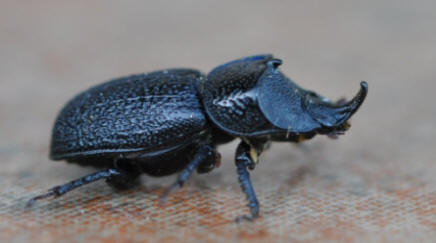
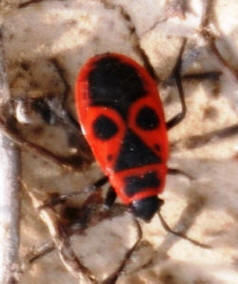
This Rugose Stag Beetle is actually a tiny little fellow despite his rhinoceros like appearance. The odd face mask staring at you is one of a group of beetles called Fire Bugs.
What do rock music and the insect world have in common? Superstars, that’s what. Here’s an easy question for you: What was the most popular rock group in history? The Beatles, of course. Now make this arthropodic leap of irony and answer this: What it the most successful group of insects in the world? Beetles, of course. The Coleoptera are in fact the largest single order or animals in the world. Much more popular than that harmonious bunch of homo sapiens with the odd spelling.
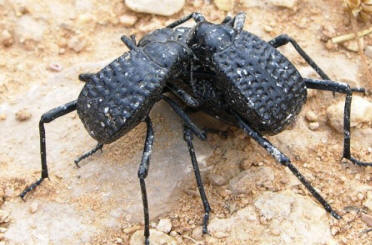
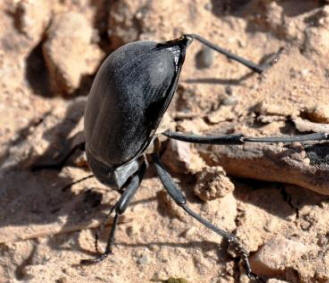
The more odoriferous side of beetles are seen here as a pair of Dung Beetles wrestle for a bit of you know what. The guy on the right standing on his head and exposing his rear end is a Darkling Beetle. Get too close to that glistening wet spot and you’ll choke like you’ve been exposed to tear gas.
Now you can argue whether or not John, Paul, Ringo, and George deserve the title or how they got it to begin with, but there is no zoological doubt in the world that beetles rule. One out of every four species in the animal kingdom is a beetle; about 350,000 different kinds and counting; over 30,000 in North America. They are among the smallest, largest, fastest, strongest, and most colorful members of the insect community. There may very well be an unnamed new member of the beetle clan in your own backyard. Get out there and look! Current theory holds that modern beetles evolved sometime during the Jurrasic period along with dinosaurs but their earliest ancestors started crawling around the earth some 265 million years ago during the Permian Period. Despite all the earthly upheaval since then Coleopterans have seen the dinosaurs and a lot of other animals come and go – yet they’re still here thriving with incredible success. Why? Let us consider a few answers to this very important question.
Anyone who visits this site is at least curious about wildlife or some aspect of it. I am utterly and unabashedly fascinated by it. But although the natural world is my consuming passion it is not the only driver of my soul. For as long as I can remember I have loved literature and writing as well. And I have this odd, expansive imagination layered on top of it. All things considered my two favorite programs as a lad were not surprising: Wild Kingdom and Twilight Zone.
For many years I wrote and dabbled, wrote and dabbled – and then one day while laying on my stomach photographing a toad in southern Afghanistan I had an idea for a book:
If you’ve ever wondered what happens when the Wild Kingdom collides with the Twilight Zone seasoned with a good deal of humor and reality (as I’m sure you have) than this collection of stories is for you. Twenty four tales – all based on real life stuff; incidents from my life in the Army, Disney, zoos, circuses, wildlife chases, and travels around the world. Check it out. I’d be honored. You don’t even need to buy it. Since Amazon lets you check it out like a library book.
Years ago I commanded an Army recruiting company in upstate New York. The job required a lot of “windshield time” as I drove from one recruiting station to another. I normally packed a lunch for these little journeys and always selected a convenient setting of natural beauty for my afternoon lunch break. One day I found a beautiful little spot just off the road near a flowing brook. I pulled over, rolled down the window, and settled into a tasty ham sandwich as I watched the gentle waters flowing by. I was hungrily into my third bite when I saw something stopped me in mid chew and made me wonder if I was hallucinating – a mouse swimming underwater.
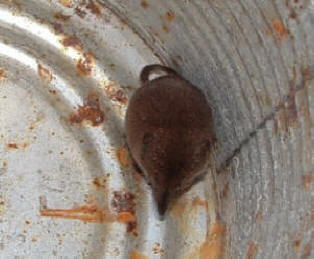
Common Shrew. Note the long, pointed snout, tiny eyes and ears. Mice have large eyes and distinct ears.
I had never seen such a thing! I carefully opened the car door and got as close as I could to the strange creature. Sure enough it was a small, mouse like mammal swimming underwater, scooting about and frantically probing between rocks and other submerged objects. What an incredible sight! I observed the little guy for about five minutes until it suddenly and swiftly disappeared. A book I’d read years before by the great animal behaviorist Dr. Conrad Lorenz popped into my mind and I realized I’d seen a water shrew.No matter how many times I stopped by that stream afterward I never saw the creature again, but it remains as one of the most memorable sights I’ve ever had the pleasure to witness.
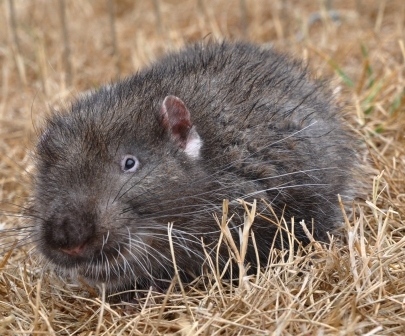
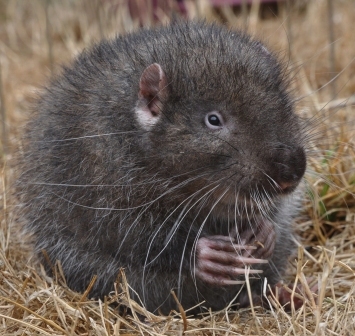
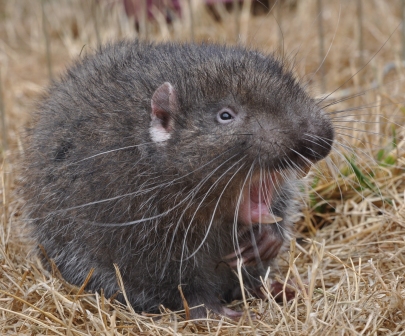
I have some GREAT neighbors living across the street from me! How great? Great enough to catch and bring a young mountain beaver over to my house so I could get some pictures. Now that’s what I call great neighbors. Thanks Mike and Lisa! (Actually it was Lisa who did all the work.)
As you can see, these guys are cute – from a certain angle. But they do have some organic weapons for self defense.
Learn more about these fascinating, uniquely Northwest rodents in an article I wrote a while ago. Click here:
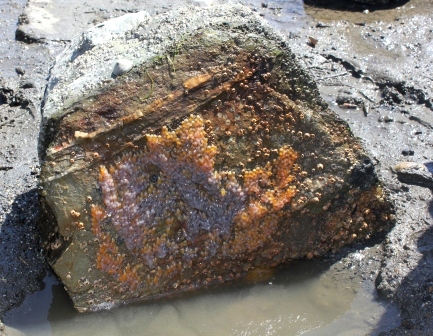
Imagine a fish that combines the head of a toad, bioluminescence, poisonous spines, and an ability to produce sound so pronounced that it was once blamed for keeping part of an entire city awake. This is no science fiction fantasy or deep sea mystery. It’s a creature that often lives under our very feet as we walk the beach during low tide. This utterly unusual animal is a fish – the Midshipman, Poricthyus notatus.
A large boulder turned over in a mud flat at low tide reveals thousands of Midshipman eggs attached to the underside.
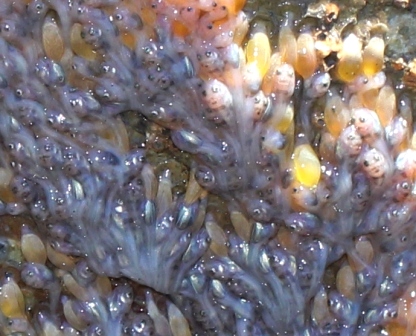
A close up shot shows how many of the little guys are well on their way to development.
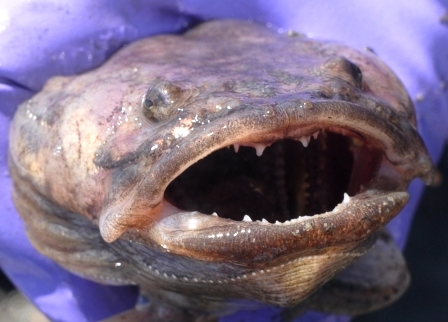
The male Midshipman who was hunkered down under the rock and a good look at the toothy mouth he used to defend his brood. Note the line of photophores under the jaw.
The name of this animal, every bit as unusual as its demeanor, originates from the rows of photophores that line the underside of the fish. Early mariners were obviously impressed at the resemblance of these organs to the buttons on a midshipman’s uniform – hence the name. Depending on the source consulted these very noticeable photophores are used to attract prey, confuse predators, or attract a mate. Most likely they are used by the creature for all of these purposes at one time or another. As expected for an animal with such an ability the Midshipman is a nocturnal species, and considering the fact that several hundred photophores line the upper ventral sides of the fish that bioluminescence must be quite a show.
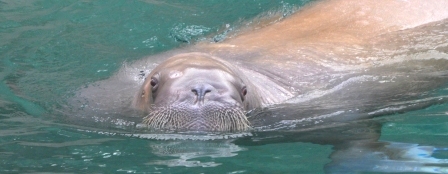
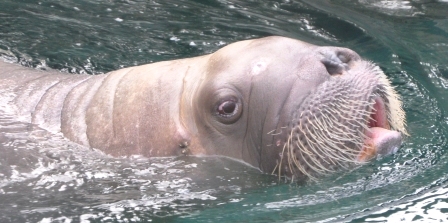
Last Thursday, 16 July 2015, the Point Defiance Zoo and Aquarium announced the death of one of its most unique animals. “ET” was a walrus named after Stephen Spielberg’s famous movie character. Discovered as an orphaned calf in Prudhoe Bay, Alaska by oil workers in 1982 the “little” guy made his way to the zoo in Tacoma where he lived for the next 33 years. ET and his kind are truly fascinating animals. They join seals and sea lions in the order Pinnipedia, meaning “feather footed,” a reference to the shape of their fins but a name that sounds oddly delicate considering the size of these animals. At about 1 ton male walruses are the biggest pinnipeds in the Arctic and outweighed in their order only by the southern elephant seal. (We have a northern elephant seal here in the Northwest, one of which made a surprising appearance in downtown Port Townsend not long ago. More on that later.)
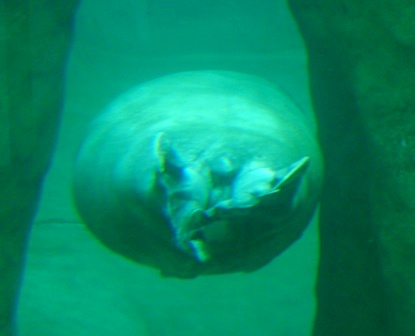
I can’t guarantee that this is the actual “ET” but it does show how entertaining and intriguing theses animals are to observe.
I have spent many enjoyable hours watching, photographing, and listening to ET at the Point Defiance zoo so it was sad to read of his passing. Along with two other walruses at the park he was an incredible sight above and below the water line. I thought I’d pass along a few photos and several intriguing facts about these extraordinary animals.
Historical records show that walruses at one time extended into Ireland and as far south as northern Spain and along the coast of Germany
The common name walrus comes from the Norse hvalroos, meaning “whale horse”
Males are about twice the size of females
Walruses change colors. They appear very light skinned, almost white in cold water but turn a noticeable pink in the sun due to blood flow
That very obvious mustache is shared by both sexes and consists of 450 extremely sensitive bristles and are used to find the bivalves walruses love so much and are the among the most sensitive of all mammal whiskers
Their ability to suck is so powerful that they are able to hold clams and mussels in their lips and suck the meat out without having to swallow the shell; the Inuit tell of walruses even sucking birds into their mouths from the surface of the water
Males have a pair of pouches arising from the pharynx that extend along the sides of the neck; these fill with air and help to produce the numerous sounds that walruses make, the most intriguing is the distinctive, clear sound of a bell. These sacs also serve as a life preserver, keeping the animal afloat with little effort
Tusks are used for defense and to maintain ice holes, not for digging up clams and such. They ram their head against the ice to open holes
References:
“A Complete Guide to Arctic Wildlife” by Richard Sale, copyright 2006
“Walker’s Mammals of the World, Volume II,” Richard M. Nowak, Sixth Edition